
Arkansas Bankruptcy Records
Arkansas bankruptcy records are public court filings held by the U.S. Bankruptcy Court. The state is divided into two federal districts. People in the eastern half of Arkansas file in Little Rock. Those in the west file through Fort Smith or the Fayetteville division office. You can search these records online using PACER, check case status by phone, or visit the courthouse in person. This guide covers where to find Arkansas bankruptcy records, what each case file holds, and how each county connects to the federal court that serves it.
Arkansas Bankruptcy Records at a Glance
Federal Bankruptcy Courts in Arkansas
Arkansas has no state-level bankruptcy court. All filings go to one of two federal courts. The Eastern District and the Western District split the state between them. Both sit within the 8th Circuit and use the same CM/ECF electronic filing platform.
The U.S. Bankruptcy Court for the Eastern and Western Districts of Arkansas maintains its main office at 300 W. 2nd Street, Little Rock, AR 72201. The phone is (501) 918-5500. This office is the primary hub for the Eastern District and handles filings for 41 counties, including Pulaski, Craighead, Jefferson, Faulkner, and Lonoke. The Bankruptcy Clerk is Jean Rolfs. Judges assigned to the court include Hon. James G. Mixon, who serves as Chief Judge, and Hon. Audrey R. Evans. The court launched its electronic case filing system in December 2001. If you need to mail a payment, use the Little Rock address regardless of which location you visit.
The official website for the U.S. Bankruptcy Court for the Eastern and Western Districts of Arkansas provides local rules, court forms, judge information, and contact details for both offices.
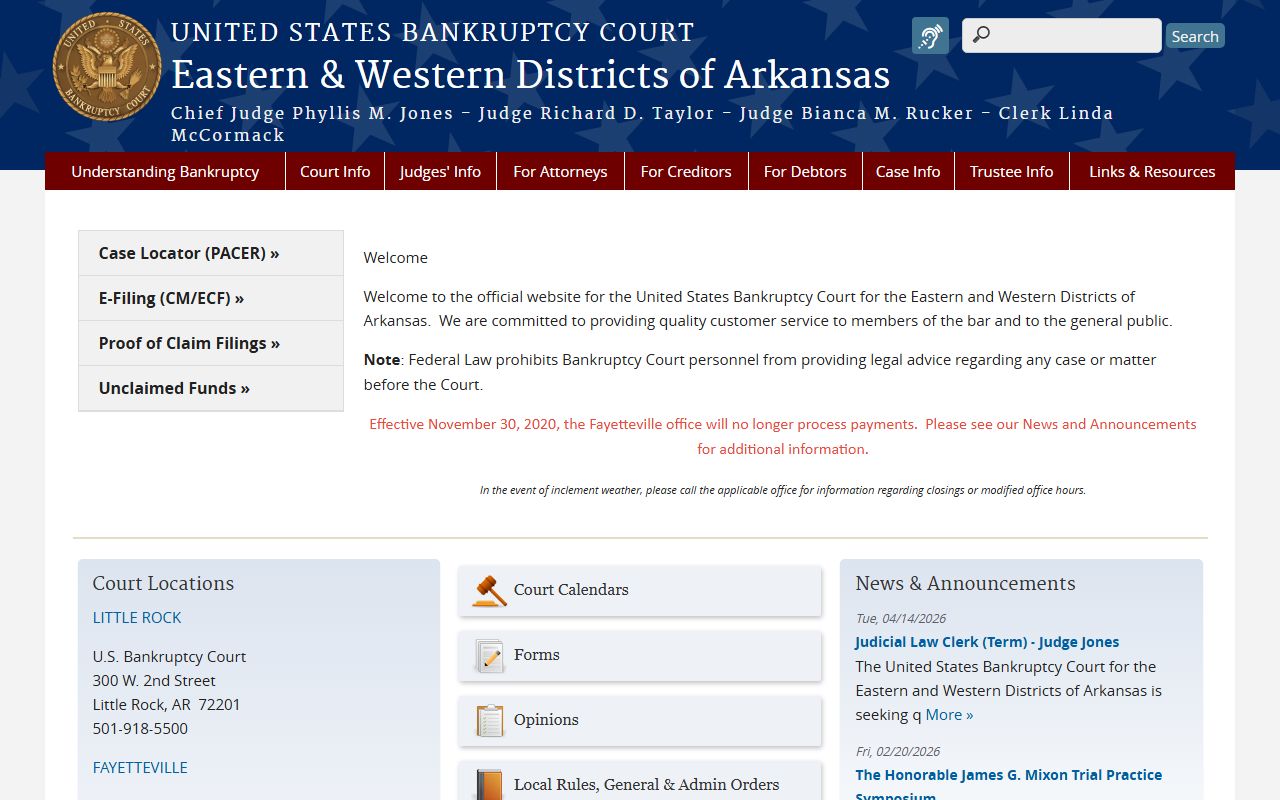
Both the Little Rock and Fort Smith courthouses accept case filings during regular business hours. The court's website is the best starting point for forms, local rules, and scheduling information.
The U.S. District Court for the Eastern District of Arkansas is located at the Richard Sheppard Arnold U.S. Courthouse, 500 West Capitol Avenue, Little Rock, AR 72201. The phone is (501) 604-5351. This federal district court has original jurisdiction over bankruptcy cases and refers them to the bankruptcy court for handling. The Eastern District covers the same 41 counties as the Eastern District Bankruptcy Court. For federal civil and criminal matters related to a bankruptcy proceeding, this is the court you will work with.
The official website for the U.S. District Court for the Eastern District of Arkansas includes information on attorney admissions, local rules, and public access to case records through PACER.
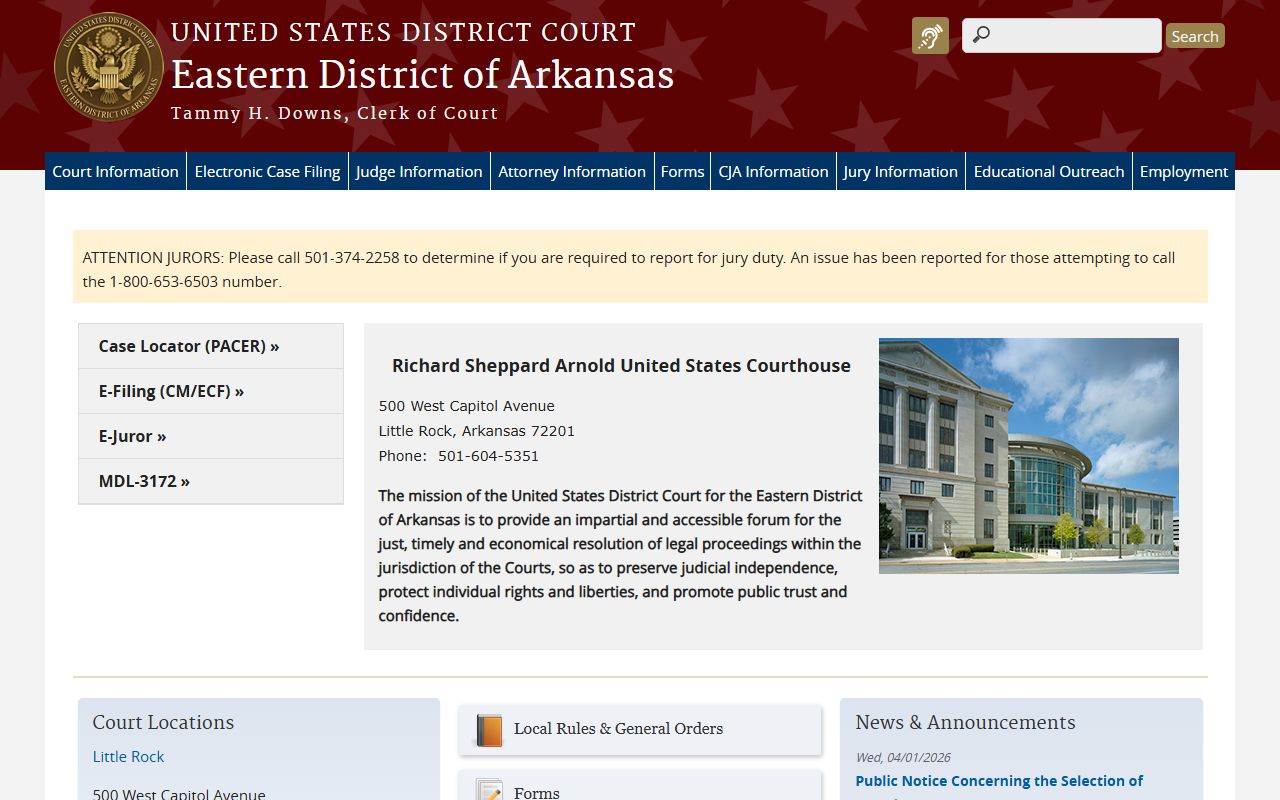
The Eastern District courthouse in Little Rock serves as the administrative center for a wide swath of the state, from the Delta counties in the east to the River Valley counties in the west.
The Western District operates out of the Judge Isaac C. Parker Federal Building at 30 South 6th Street, Room 1038, Fort Smith, AR 72901. Call 1-833-853-0345 for general inquiries. A division office is also open in Fayetteville at 35 E. Mountain Street, Room 316, with a direct line of (479) 582-9800. Cash is not accepted at the Fayetteville office. Send any cash payments to the Fort Smith address. Additional division offices are located in Hot Springs, El Dorado, and Texarkana. The Western District covers 38 counties, including Benton, Washington, Sebastian, Garland, and Crawford. The U.S. District Court for the Western District of Arkansas maintains its headquarters at the same Fort Smith location and handles federal cases across the western region.
The website for the Western District of Arkansas provides public access to case records, local court rules, attorney information, and links to PACER for electronic record searches.
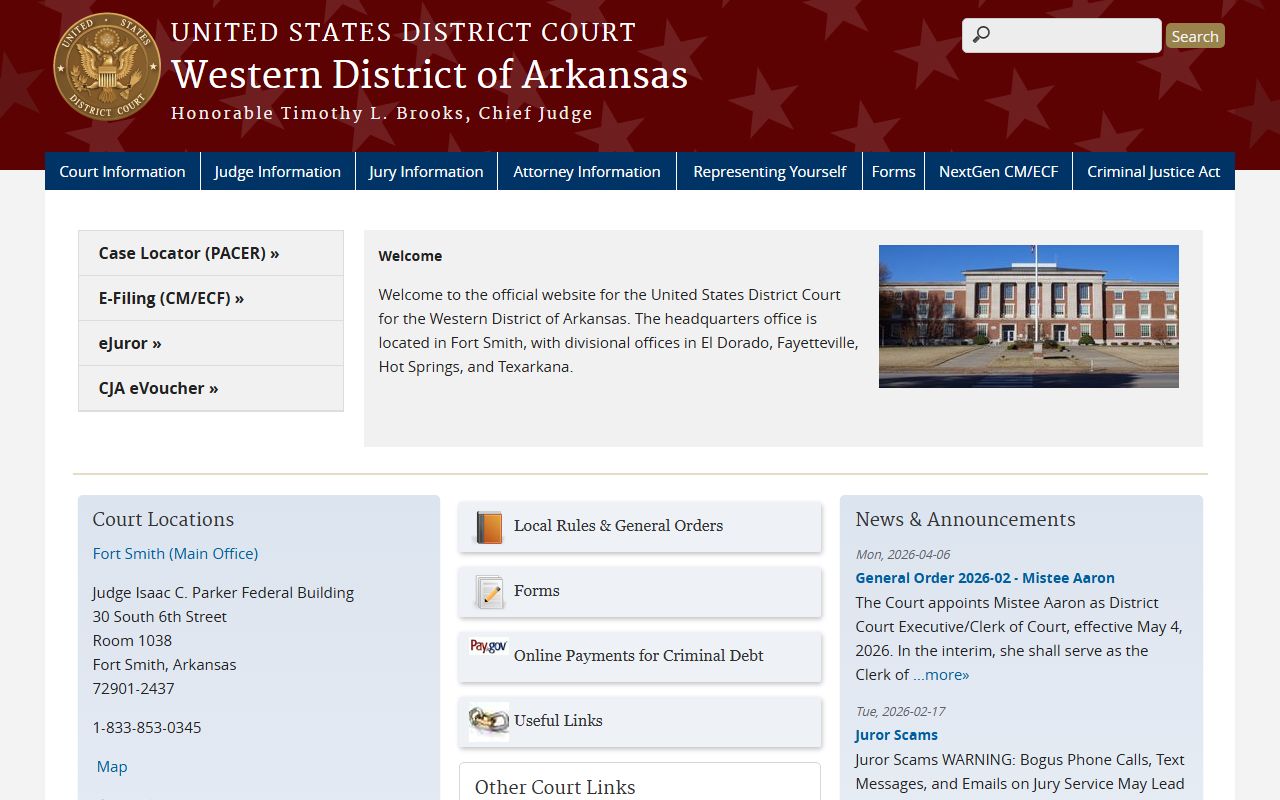
Attorneys representing clients in Western District bankruptcy cases must file all documents electronically through CM/ECF. If you are handling your own case without an attorney, you must submit paper documents in person at the courthouse. Electronic filing for self-represented parties is only allowed by specific court order.
Search Arkansas Bankruptcy Records Online
Three main tools give you access to Arkansas bankruptcy records online. PACER covers federal court filings. The PACER Case Locator helps when you are unsure which district filed the case. Arkansas CourtConnect covers state circuit court records and can fill in the picture with civil judgments and liens that appear alongside bankruptcy cases.
PACER stands for Public Access to Court Electronic Records. It is run by the federal judiciary and covers all federal courts, including both Arkansas bankruptcy districts. You can search by debtor name, case number, or the last four digits of a Social Security number. Once you find a case, you can view the full docket, download documents, check hearing dates, and track case status in real time. The cost is $0.10 per page with a cap of $3.00 per document. Accounts with less than $30 in charges per quarter are not billed at all. Sign up at pacer.uscourts.gov. Registration is free. Supply a credit card for same-day access, or register without one and receive login credentials by mail within about a week. The PACER Service Center can answer billing questions at (800) 676-6856, Monday through Friday, 7 a.m. to 6 p.m. Central Time.
The PACER system provides online access to case file documents, listings of all parties, case chronologies, claims registries, and listings of new bankruptcy cases filed in both Arkansas districts.
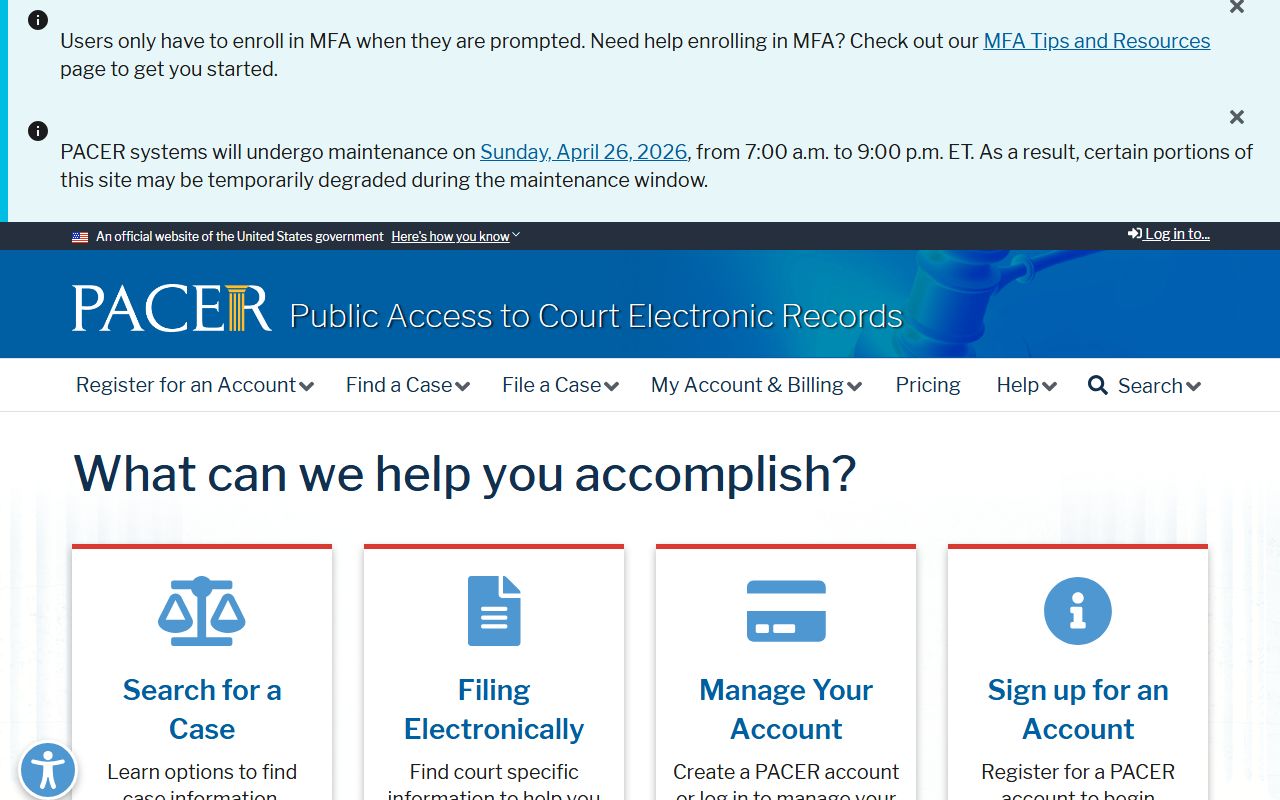
Once logged in to PACER, use the CM/ECF Lookup tool to navigate directly to the Arkansas Eastern or Arkansas Western Bankruptcy Court and search cases within that district.
The Eastern District of Arkansas Bankruptcy Court is also listed directly in the PACER court lookup tool. This page shows the court's software version, go-live date, and file size limits for electronic filings. The system runs on NextGen CM/ECF Release 1.8. The maximum PDF file size for a single document is 10 MB, and the maximum merged document size is 30 MB. These limits apply to attorney filings only.
The PACER court lookup for the Arkansas Eastern Bankruptcy Court confirms the court's 8th Circuit assignment and provides direct links for registering to file electronically in that district.
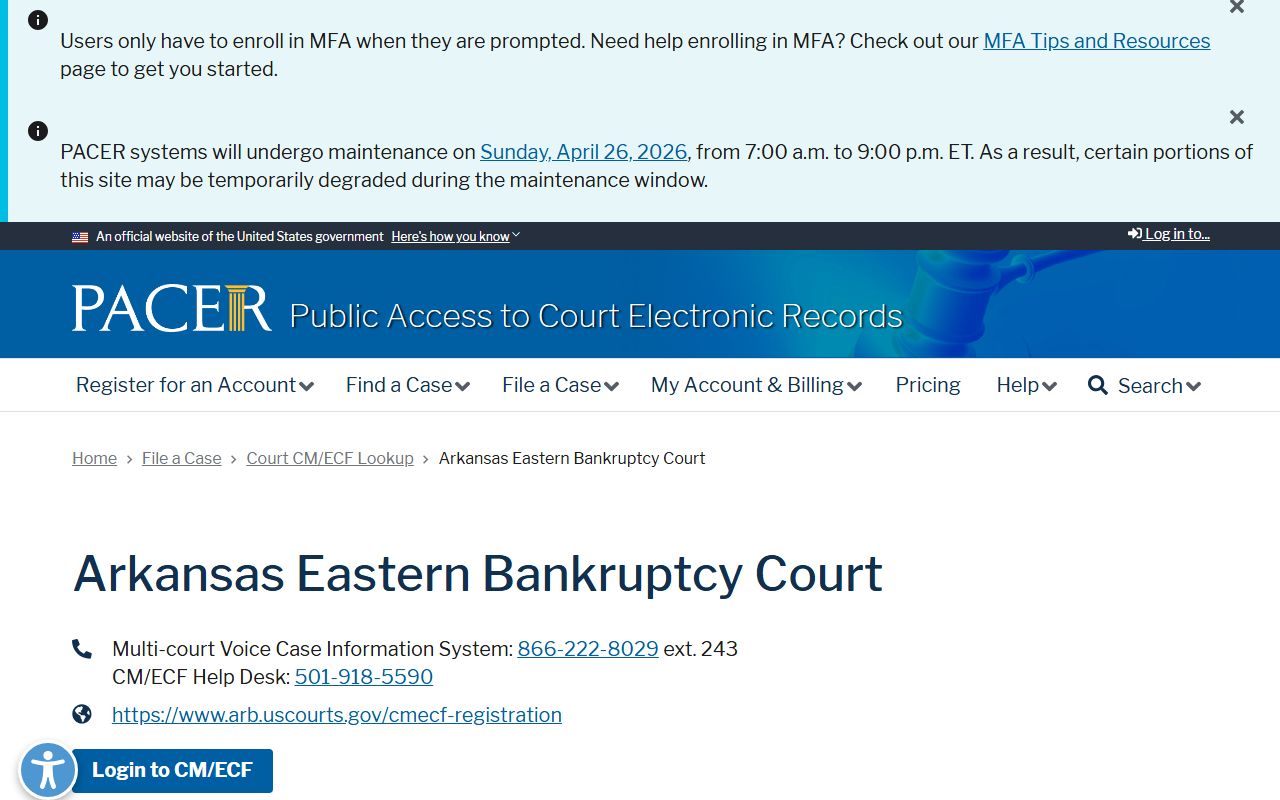
Use the PACER court lookup to confirm which court a case is filed in before submitting a records request or searching the docket.
The PACER Case Locator is a national index updated each night from data pulled across all federal courts. Visit pcl.uscourts.gov to use the tool. You can filter results by court type, region, and date range. This is the fastest way to find out which of the two Arkansas districts holds a particular bankruptcy case. You still need a PACER account to log in. The Case Locator also lets you save searches and set up alerts for specific cases or parties.
The PACER Case Locator serves as the starting point for a nationwide search of federal court records, pulling data nightly from appellate, district, and bankruptcy courts across all jurisdictions.
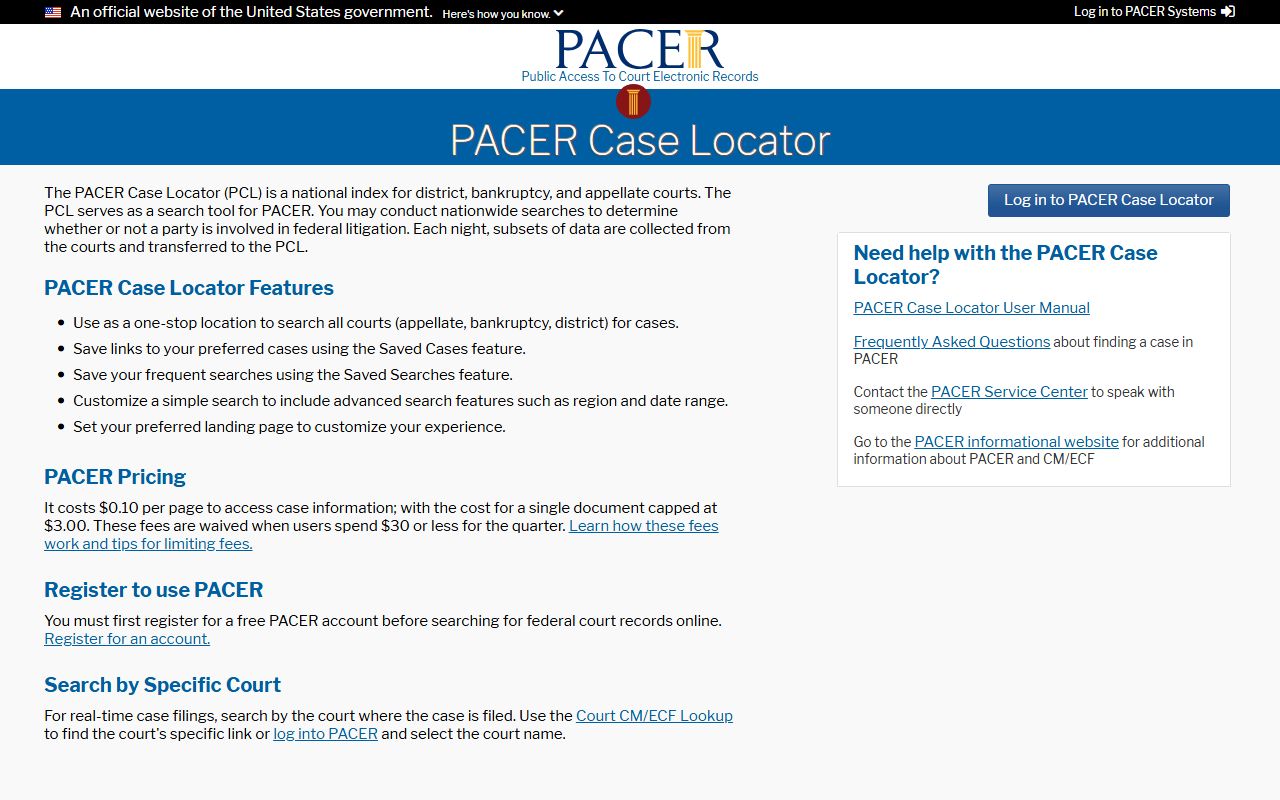
The Case Locator is particularly useful when you do not know whether a debtor filed in the Eastern or Western District of Arkansas, or whether they filed in a different state entirely.
Arkansas CourtConnect is the state's free public court portal. Access it at caseinfo.arcourts.gov. This system does not show federal bankruptcy cases. It does cover state circuit court records, which include civil judgments, liens, foreclosures, and domestic relations cases that often appear alongside a bankruptcy. Searching it gives you a fuller picture of a debtor's legal history in Arkansas state courts. Search by party name, case number, business name, or case type. The system uses the Contexte Case Management System and covers most counties from approximately 2009 forward. For help, call the Administrative Office of the Courts at (501) 410-1900, option 1, or toll-free at (866) 823-5778.
The Arkansas Judiciary's Search ARCourts portal allows the public to look up circuit court case information by party name or case number across participating counties statewide.
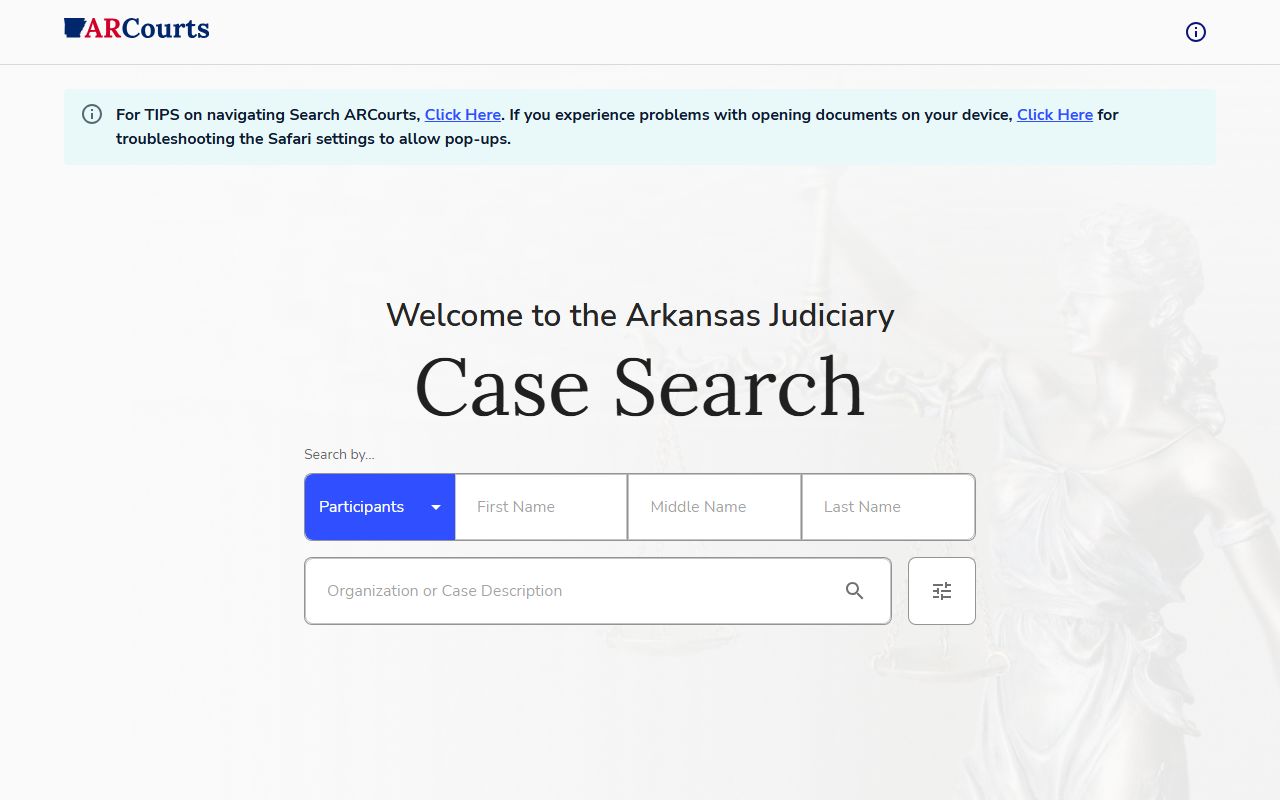
CourtConnect is free to use and requires no registration. Results include case status, party names, filing dates, docket entries, and upcoming hearing dates for open cases.
You can also get basic case information without logging in to any system. The Multi-Court Voice Case Information System operates 24 hours a day. Call 1-866-222-8029 and enter extension 243 for the Arkansas Eastern Bankruptcy Court. The automated system reads back the case number, debtor name, filing date, chapter filed, case status, and trustee assigned. You need the debtor's name or case number to pull a record. This service is free.
Note: PACER covers federal bankruptcy filings only. State court judgments, property liens, and related civil actions are in the Arkansas CourtConnect system or at the county Circuit Clerk's office. Both may be relevant when researching a bankruptcy case.
What Arkansas Bankruptcy Records Contain
Federal bankruptcy case files are detailed public documents. They track every stage of a case from the initial petition to the final discharge or dismissal. Most of this information is open to anyone who requests it.
A standard Arkansas bankruptcy record includes the debtor's full legal name, the case number, the chapter filed under, the county of residence or principal business location, the last four digits of the Social Security number or tax identification number, the date of filing, the type of debtor, the nature of debts, a full list of creditors with amounts owed, the name of the court-appointed trustee, and the case discharge date along with any conditions attached to it. If the debtor has filed for bankruptcy in the past, that prior history also appears in the record.
The voluntary petition is the first document filed and the most referenced. It shows the debtor's address, prior bankruptcies, the chapter sought, and whether the debtor is an individual, joint couple, corporation, or other entity. The schedules that follow are equally important. Schedule A and B cover all property owned, including real estate, vehicles, bank accounts, retirement accounts, and personal goods. Schedule C lists what the debtor claims as exempt property. Schedules D, E, and F name every secured and unsecured creditor along with the balance owed. The Statement of Financial Affairs covers income from the prior two years, payments to creditors made in the 90 days before filing, pending lawsuits, and any property transferred out of the debtor's possession within two years of the filing date. These documents make up the core of the public case record in both Arkansas districts.
Some data is redacted. Social Security numbers appear only as the last four digits in public records. Bank account numbers and credit card numbers are partially hidden. Cases that involve minors have restricted access. Sealed filings do not appear through the public PACER portal.
Bankruptcy Chapters Filed in Arkansas
Arkansas debtors file under the same federal chapters as every other state. Chapter 7 and Chapter 13 are the most common by far. Chapter 11 handles business reorganizations and large personal cases. Chapter 12 is built for family farmers and family fishermen.
Chapter 7 is a liquidation. A court-appointed trustee reviews the debtor's assets, collects any non-exempt property, sells it, and pays creditors from the proceeds. Most Chapter 7 cases close within four to six months and result in a discharge. The administrative fee for a Chapter 7 petition is $78, which is part of the total filing fee. Many Arkansas filers keep all of their property because it falls under state or federal exemptions. The means test is the first hurdle. If your income is above the Arkansas median, you may need to pass a secondary test or convert to Chapter 13. Below the median, you generally qualify to file.
Chapter 13 is a repayment plan. You propose a three to five year plan to pay back some or all of your debts. You keep your property throughout the case. This chapter works well for catching up on missed mortgage payments, paying back taxes, and keeping assets that would be sold in a Chapter 7 case. The administrative fee for a Chapter 13 petition is $78 as part of the total $313 filing fee. A trustee collects your monthly plan payments and distributes them to creditors based on the confirmed plan. If you complete the plan, remaining eligible debts are discharged.
Chapter 11 is for businesses that want to stay open while restructuring debt. The administrative fee for a Chapter 11 petition is $571 as part of the full filing package. Chapter 12 applies to family farmers and family fishermen. It works like Chapter 13 but has flexible rules that fit seasonal income patterns. Both Chapter 11 and Chapter 12 are far less common in Arkansas courts than Chapter 7 or 13.
Arkansas Bankruptcy Exemptions Explained
When you file bankruptcy in Arkansas, certain property is off-limits to creditors. This property is exempt. Arkansas gives filers a choice: use Arkansas state exemptions or the federal exemption set. You cannot mix the two. Most people compare both lists and pick whichever one protects more of what they own.
The homestead exemption is the most significant protection in Arkansas bankruptcy law. Under Arkansas Code Section 16-66-210, the home of a married resident or head of family cannot be seized to satisfy a court judgment. Rural homesteads can cover up to 160 acres of land along with any improvements on it. The value cap is $2,500, but the court cannot reduce the protected area below 80 acres regardless of what the land is worth. Urban homesteads, meaning homes inside a city, town, or village, can cover up to 1 acre. The same $2,500 value cap applies, and the minimum protected area is one-quarter acre. This exemption has been part of Arkansas law since the Homestead Exemption Act of 1981 and reflects the state's strong tradition of protecting primary residences from creditor actions.
The Arkansas statute governing the homestead exemption is available through the Justia legal database, which provides direct access to the current text of the Arkansas Code as enacted by the state legislature.
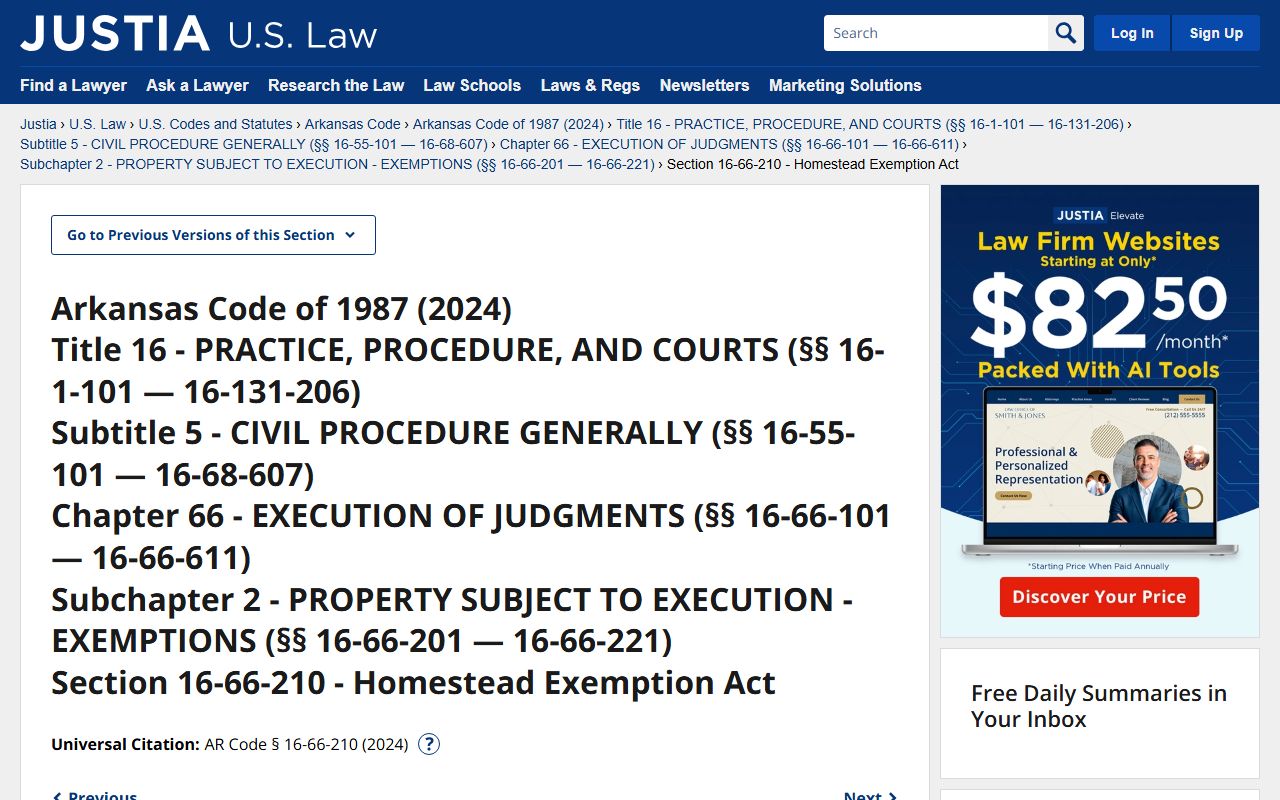
The homestead exemption applies to both Chapter 7 liquidation and Chapter 13 repayment cases, protecting the family home from being sold to pay unsecured creditors.
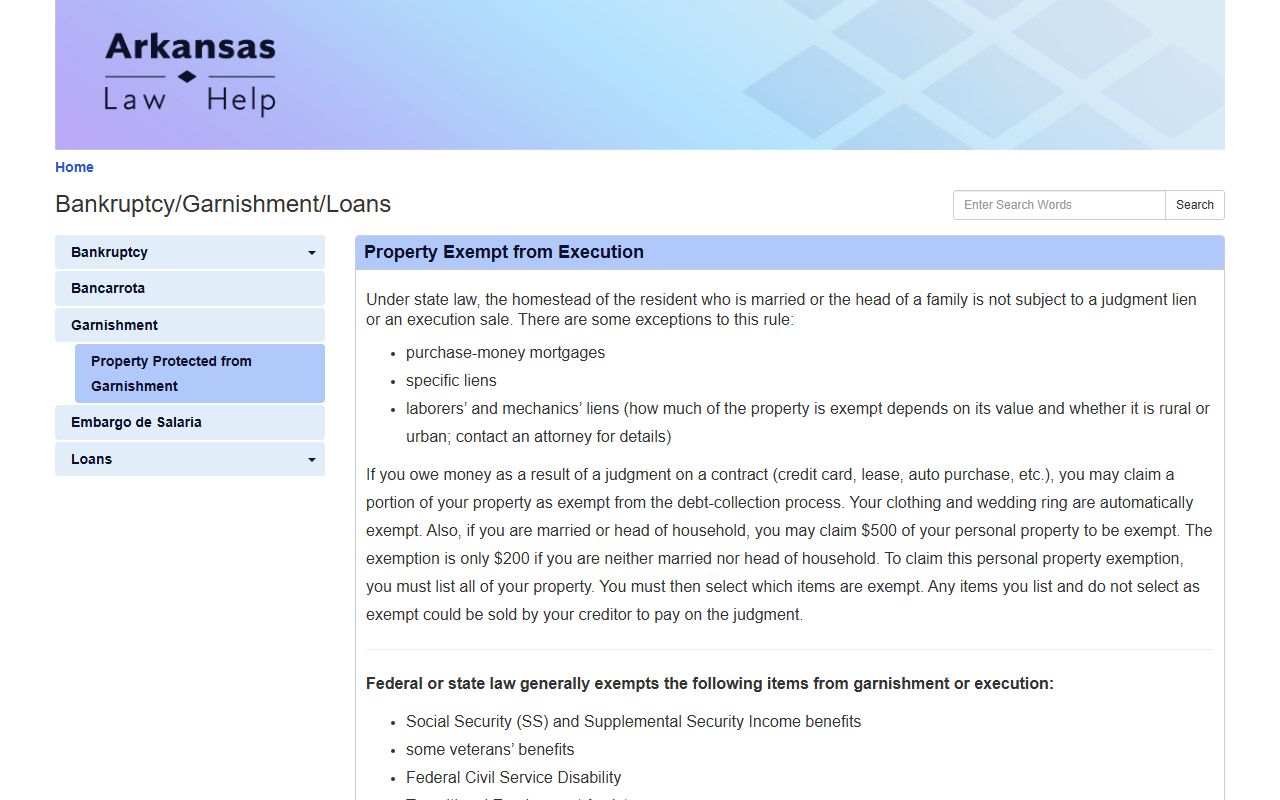
Personal property exemptions run alongside the homestead. Your clothing and wedding ring are automatically exempt with no dollar limit. Married filers and heads of household can claim up to $500 in personal property as exempt. Single filers with no dependents can protect $200. Beyond those amounts, Arkansas law also shields specific types of income and benefits from creditors. Social Security, Supplemental Security Income, and some veterans' benefits cannot be garnished. Unemployment compensation and workers' compensation receive the same protection. State police retirement and teachers' pension funds are also exempt. Health, life, accident, and disability insurance proceeds are protected as well. The Arkansas Legal Aid resource on protected property covers these income exemptions in plain language.
The Arkansas Legal Aid guide on property protected from garnishment explains which wages, benefits, and personal property are off-limits to creditors under both state and federal law.
If a piece of property is secured by a loan, such as a car or mortgage, and you are current on payments with equity covered by exemptions, you may choose to keep making payments and hold on to the asset through the bankruptcy case.
Note: Arkansas lets you choose between state and federal exemptions, but you cannot combine both sets in the same filing. Review both lists with a bankruptcy attorney before deciding which set of exemptions to claim.
Court Fees and Copy Costs
Accessing records through PACER costs $0.10 per page, up to a maximum of $3.00 per document. Quarterly accounts with less than $30 in total charges are not billed. The PACER Service Center handles billing at (800) 676-6856, Monday through Friday, 7 a.m. to 6 p.m. Central Time. PACER fees apply uniformly to both the Eastern and Western Districts of Arkansas.
Paper copies requested directly from the court cost $0.50 per page. Certified copies of a court document carry a $12 certification fee on top of the copy cost. Exemplified copies, which carry the highest court authentication, cost $24. Audio recordings of court proceedings run $34 per recording. Transmitting an electronic record stored outside the court's primary case management system costs $33 per record. Searching the court's records costs $34 per name or item searched. These fees are set at the federal level and apply equally in both Arkansas districts.
Filing an amendment to the debtor's schedule of creditors or mailing list after the initial filing costs $34. This fee applies when you add creditors or update addresses after the case opens. Filing a complaint within a bankruptcy case costs $350, though certain parties such as trustees and qualifying child support creditors may be exempt from this fee. Appeals from a court order or judgment carry a $293 filing fee.
Reopening a closed bankruptcy case also has a fee. Chapter 7 reopening runs $245. Chapter 13 costs $235 to reopen. Chapter 11 and Chapter 9 each cost $1,167 to reopen. Fee waivers are available in limited circumstances but are not routinely granted.
Public Access to Arkansas Bankruptcy Filings
Yes. Bankruptcy records in Arkansas are public. The Federal Records Act and the Freedom of Information Act give any person the right to view and copy these filings. You do not need to be a party to the case. No reason is required.
Online access through PACER at pacer.uscourts.gov is the easiest way to search both Arkansas districts. The court also accepts in-person requests at the Little Rock courthouse, 300 W. 2nd Street, Little Rock, AR 72201, and at the Fort Smith courthouse, 30 South 6th Street, Fort Smith, AR 72901. Court staff can pull records and make copies for the standard fees listed above. Mail requests work for specific documents if you include the case number, debtor name, the documents needed, and payment information. Call the court ahead of time to confirm their current mail request procedures.
Certain information is redacted from all public records. Social Security numbers appear only as the last four digits. Full account numbers for banks and credit cards are partially hidden. Cases involving minors have restricted access. Sealed filings are not available through the public portal. A party can petition the court to seal a record, but judges grant these requests only when there is a clear and compelling reason. For the vast majority of bankruptcy cases, what was filed is what the public can see.
The Arkansas Association of Counties publishes contact information for all 75 county Circuit Clerks and County Clerks. These offices maintain state court records that often intersect with federal bankruptcy cases, including property deeds, judgment liens, foreclosure records, and related civil actions. Checking both the federal bankruptcy record and the county-level state court records gives the most complete picture.
The Arkansas Association of Counties directory provides comprehensive contact details for county clerks and officials across all 75 counties, serving as a useful resource for locating state-level court records that may accompany a bankruptcy case.
Each county's Circuit Clerk maintains land records, judgment liens, and civil case files that may appear alongside a federal bankruptcy proceeding. Contacting the county clerk directly is often the fastest way to get those records.
Arkansas Bankruptcy Records by County
Each of Arkansas's 75 counties connects to one of the two federal bankruptcy districts. Find your county below to access the local courthouse, Circuit Clerk contact details, and record search resources for that area.
Bankruptcy Records in Major Arkansas Cities
Arkansas cities rely on the county Circuit Clerk and the federal bankruptcy court for their district. Select a city below to find the right courthouse contacts and record resources for that location.